

Electronic nose system
Overview
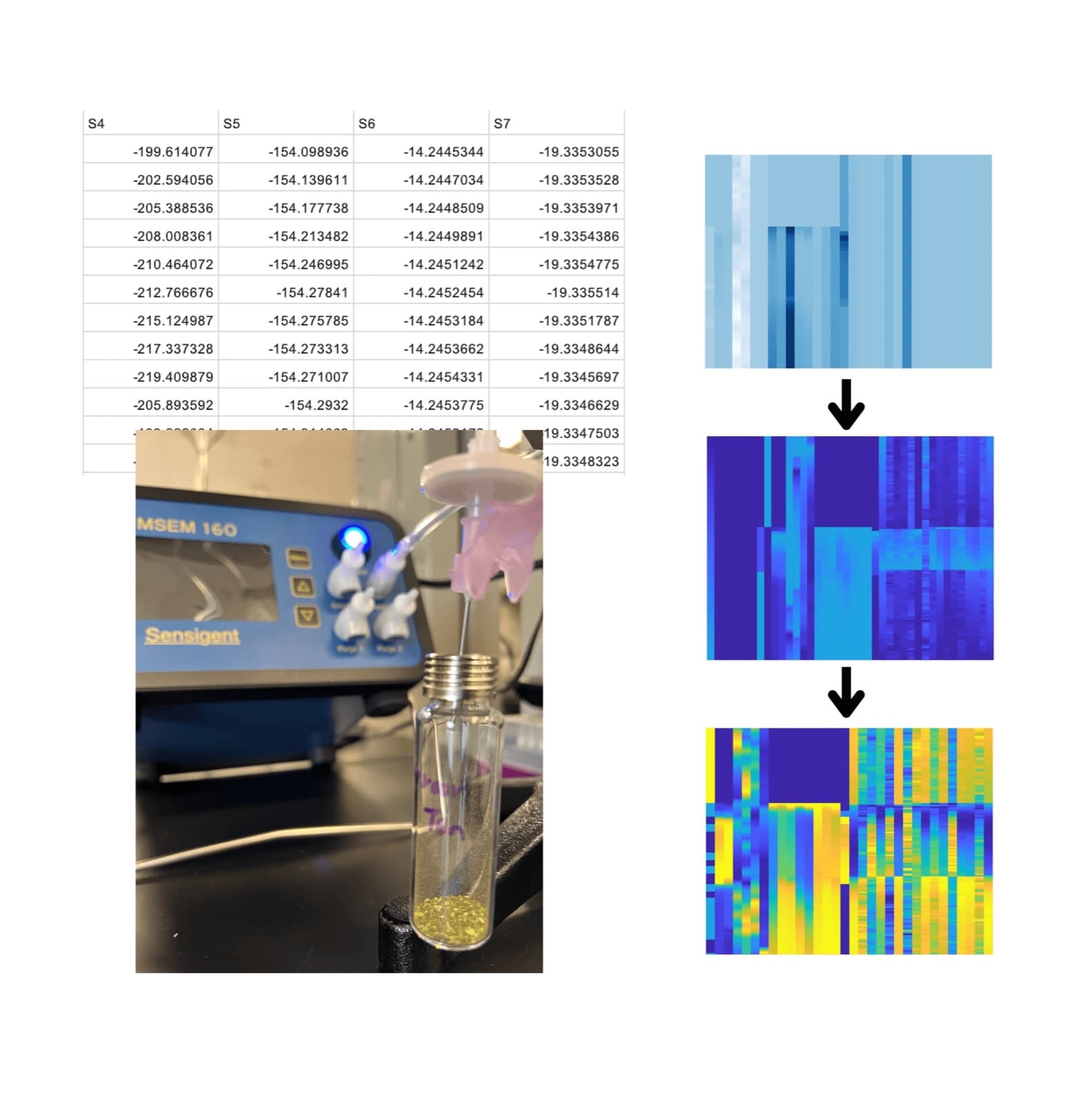
The development of artificial intelligence (AI) and electronic nose (eNose) offers a promising embedded system to replicate human olfactory functions. This project aimed to translate and join the numerical eNose signal array into a 2-dimensional image representation, thus allowing pre-trained CNN to discern the features present in odor signatures at an accuracy of over 90%.
An image representation of the eNose multichannel sensor signals was successfully produced using mathematical toolkits available from Seaborn in a Jupyter Lab interface as well as in MATLAB. Transfer learning was successfully carried out using GoogLeNet, a pre-trained image classifier. The final training accuracy that the model achieved was 95.8%. The model successfully predicted unseen jasmine samples with a high prediction probability of 92.8±3.5% and oolong samples at 99.6±1.3% (95 percent confidence interval).
The results of the testing dataset revealed a precision of 0.94, a recall of 1.0, and an F1-score of 0.97, indicating a highly accurate and reliable model. The data was also classified using traditional machine learning techniques such as Support Vector Machine (SVM), K-Nearest Neighbors (KNN), and Ensemble classification, which produced poor accuracies.